
The discovery of new hominin fossils unearthed in a cavity of the Thomas I quarry in Casablanca was announced on Wednesday in Rabat, shedding new light on a key period in human evolution.
The announcement was made during a meeting attended in particular by the minister of Youth, Culture and Communication, Mohamed Mehdi Bensaid, alongside the publication of a study in the journal “Nature” by an international research team. The study presented the analysis of new hominin fossils uncovered in a cavity of the Thomas I quarry in Casablanca, as part of the Moroccan-French program “Prehistory of Casablanca.”
This program falls within the framework of institutional cooperation between Morocco’s National Institute of Archaeology and Heritage Sciences (INSAP) and the French Ministry for Europe and Foreign Affairs, through the French archaeological mission “Casablanca,” and is co-directed by Abderrahim Mohib (INSAP), Rosalia Gallotti (University of Montpellier Paul Valéry & LabEx Archimède), and Camille Daujeard (MNHN/CNRS-HNHP).
On this occasion, Mohib said that the results of this study are part of the Moroccan-French research program “Prehistory of Casablanca” and of the institutional collaboration between INSAP and several international institutions and universities.
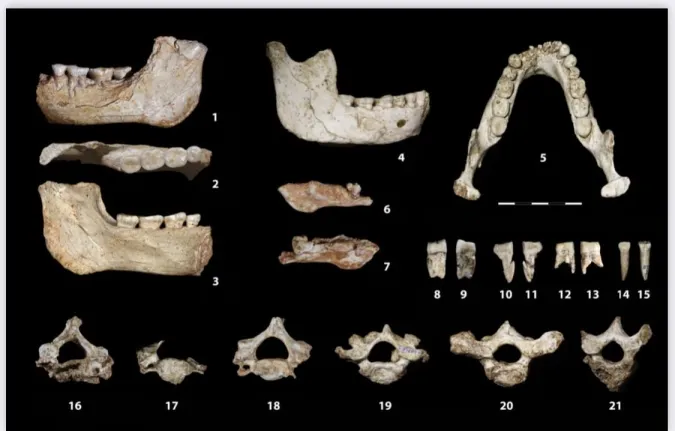
The material studied, which includes several human mandibles (two adults and a child) as well as dental and post-cranial remains, combines archaic characteristics observed in Homo erectus with more derived, modern traits, he added.
He further specified that the sediments forming the infill of the cavity and containing the fossil remains yielded a high-resolution record of the Matuyama–Brunhes magnetic reversal, dated to 773,000 years ago, thus providing one of the most precise and robust ages for a site that has yielded human remains.
The magnetostratigraphic analysis, of unprecedented resolution for a site containing hominin remains, made it possible to date these fossils with extraordinary precision, the professor added, noting that the assemblage documents human populations that are still poorly known for this pivotal period, situated between early forms of the genus Homo and more recent lineages.
These discoveries fill an important gap in the African fossil record at a time when paleogenetic data place the divergence between the African lineage leading to Homo sapiens and the Eurasian lineages that gave rise to Neanderthals and Denisovans, he added, explaining that the fossils display an original combination of primitive and more evolved characteristics, attesting to human populations close to this phase of divergence.
They thus confirm the antiquity and depth of the African roots of our species, while underscoring the key role of North Africa in the major stages of human evolution.
Thanks to precise dating based on records of the Earth’s magnetic field, these remains can be placed with great chronological reliability in the ancient history of human populations in Africa. They shed light on the emergence of the Homo sapiens lineage and reinforce the idea that its deep roots are African.
For his part, Bensaid emphasized that this discovery is the result of sustained scientific work carried out by the National Institute of Archaeological Sciences and Heritage, in partnership with international universities and institutions, over several years of field research and academic analysis, with the contribution of professors, researchers, and students.
The minister also noted that the announcement of this discovery coincides with its publication in the journal Nature, one of the world’s most important scientific journals, reflecting its scientific and international significance. He expressed Morocco’s pride in its national scientific expertise, which conducts research at this level and contributes to the enrichment of human knowledge.
This discovery once again confirms Morocco’s distinguished place on the global map of archaeological research, following the earlier revelation of the oldest Homo sapiens at the Jbel Irhoud site, taking us back to an even earlier period in human history, prior to the emergence of Homo sapiens, he added.
This discovery is part of a series of major archaeological finds made in Morocco over recent decades, which have documented key stages in the history of human evolution, notably the discovery of the remains of the oldest Homo sapiens at the Jbel Irhoud site, thereby reinforcing the Kingdom’s position as one of the essential regions for understanding the deep roots of humanity.
MAP: 07 January 2026